
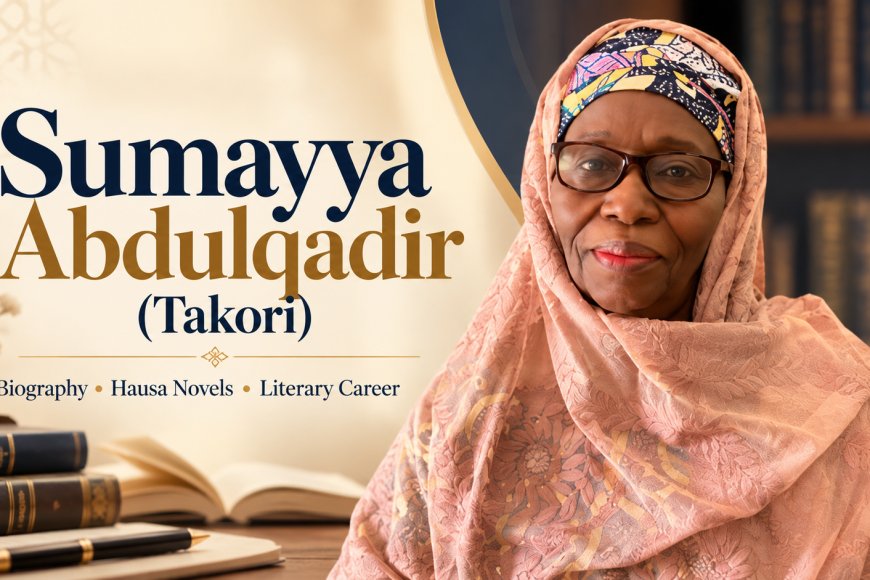
Sumayya Abdulqadir (Takori): Biography, Hausa Novels, Writing Career and Literary Influence
Sumayya Abdulqadir, widely known by the literary name Takori or Takori Kabara, is a Hausa-language novelist from Kano, Nigeria, whose work spans family relationships, education, questions of identity, social expectations, and the difficult decisions that shape everyday life. For readers who know her through the four-part novel Amani, her writing belongs to a much wider body of fiction: in an extensive interview conducted in December 2023, she described a career beginning in 2002 and identified approximately 30 works, including projects in progress.
Her career also illustrates the evolution of Hausa popular fiction from printed books and local distribution networks into internet-based reading communities. Her experience is unusually well documented because she has spoken publicly about how she writes, what inspires her characters, how she researches unfamiliar subjects, and the financial realities of publishing. The following profile brings that first-hand testimony together with the books available on Hausanovels26 and other publicly documented works, distinguishing her own statements from our editorial interpretation.
Early Life and Education in Kano
In an interview with Hikaya/Bakandamiya Books, Takori stated that she was born in 1988 in Kabara, within Kano Municipal, Kano State. Her early schooling included nursery education at Fedwa Nursery School within the Federal College of Education, Kano, followed by Masallaci Special Primary School and Gidan Galadima Primary School. She said she completed primary education in 1998.
She later attended Izazuddeen Foundation in Sani Mainagge, Special Education School in Kano, and WTC Kano for her senior secondary education. Her university studies took her to Bayero University Kano, where she reported earning a diploma in Social Policy and Administration (2006–2008), then studying Sociology from 2012 to 2015. She also described postgraduate work in special education, a field that would become relevant to the social questions explored in some of her novels.
At the time of that interview, conducted on 1 December 2023 and published in May 2024, she said she worked within Nigeria's federal disability administration. Because employment can change, this should be understood as her reported position at that time, rather than a claim about her current post.
What makes this education relevant to her literary work is not merely the accumulation of qualifications. Her training in sociology and social policy offers useful context for a writer consistently interested in how families, institutions, disability, class, education and personal choices shape people's lives. That connection is an editorial reading of her career, not an assertion that every novel was consciously built around an academic theory.
How Her Writing Career Began
Takori dates the beginning of her writing to 2002, when she was still a student. She told Hikaya that she frequently found herself writing at school and in Islamic classes, without initially setting out to publish books. This is an important distinction: her account presents writing first as a personal habit and imaginative practice, before it became a sustained literary career.
By the time of her December 2023 interview, she had spent roughly two decades working in Hausa fiction. She spoke about manuscripts, research, publishing, and readers with the perspective of someone who had experienced both traditional print circulation and newer online distribution. She also described help from her parents, friends and trusted readers who reviewed her work or offered suggestions.
Her account challenges the assumption that popular Hausa fiction is necessarily produced without craft or sustained effort. She said a single story could take her at least six months to complete, and she emphasized investigating subjects she did not already understand. Some novels required specialized reading and consultation; for others, she traveled to understand the setting more closely.
The Works of Sumayya Abdulqadir (Takori)
Takori supplied an extensive bibliography in her Hikaya interview, naming titles such as Siraɗin Rayuwa, Tuna Baya Shine Roƙo, Alheri, Girma Ya Faɗi, A Bari Ya Huce, Alƙawari Bayan Rai, Zuciyar Mutum Birninsa, Wasan Ƙanin Miji, Zumuntar Kenan, Rayuwar Rayhana, Kwana Sittin, Sanadin Kenan, Auren Kwangila, Aalimah, Masarautarmu, Amana Ta, Yiwa Kai Hisabi, Babban Goro, Yakanah, Aure Ko Boko, Hasna'u 'Yar Najeriya, Kulsum, Fahhimah, Na Huce, Sakacin Waye?, Raunin Zuciya, Amani, and Hauwa-Kulu.
These are titles she identified herself; the list is not a claim that every work is hosted or licensed by Hausanovels26. Similarly, a multi-part novel can appear as several catalogue entries even though it is one continuous narrative. Readers should distinguish the number of book files from the number of distinct literary works.
Amani: The Four-Part Novel Available on Hausanovels26
On Hausanovels26, readers can currently find Amani across four separate book entries. This makes it a particularly useful starting point for understanding Takori's fiction and for connecting this author profile to material already indexed on the website.
The accessible excerpts reveal a story that uses close family relationships and marriage to lead into increasingly complex questions of origin, belonging, secrecy and status. The narrative moves between domestic life and a much wider social and political landscape, including connections between northern Nigeria and Niger. The revelations involving Amani and Mukhtar demonstrate how a romance or family plot can grow into a larger examination of kinship, identity and responsibilities that characters did not know they carried.
One distinctive aspect of the story is the way everyday details coexist with high-stakes discoveries. Household routines, conversations, preparations for marriage, journeys and relationships make the characters' world recognizable. Against that familiarity, the revelation of concealed family histories changes the reader's interpretation of earlier events. This technique turns private decisions into questions with consequences for several generations.
For readers encountering Takori for the first time, Amani is best approached in order, beginning with Part 1. Reading later parts first may reveal major identity and relationship developments before the earlier chapters have established their significance.
Rayuwar Rayhana: Education, Opportunity and the Inner Life of a Character
Of all the novels she had written by 2023, Takori identified Rayuwar Rayhana as her personal favorite. Her explanation was especially revealing: she said she gave the central character some of her own characteristics, while making clear that the plot as a whole was fictional.
Published excerpts begin with a family confronting financial hardship and the struggle to keep a young girl's education moving forward. The early chapters locate that problem within a specific community, paying attention to local livelihoods, responsibilities and the small decisions that define a household under pressure. Later sections follow educational experience and the movement between different social environments.
This combination gives Rayuwar Rayhana a distinctive social dimension. School fees, mobility, opportunity, care and the meaning of independence are not simply background decorations; they help explain the pressures facing the characters. Readers interested in how Hausa fiction can address education and social mobility may find it a particularly rewarding point of comparison with Amani.
Takori has publicly noted a connection between the protagonist and aspects of her own experience. That does not make the novel a memoir, nor should it be treated as a reliable record of events in her private life. Her interview expressly presented the narrative as fiction.
Sakacin Waye?: Ambition, Expectations and the Cost of a Dream
Sakacin Waye? has a distinctive place in discussions of her work because it received wider attention beyond manuscript and download catalogues. A BBC Hausa feature about notable books discussed in 2023 included the novel among its selections. The feature described a young woman whose determination to realize an imagined life drives her into painful conflict, including separation from her family, before she discovers that not every desired future can be achieved in the form one first imagines.
That premise supports an important reading of Takori's storytelling: aspiration is not automatically a virtue or a flaw. It can be a source of courage, but it can also prevent a character from recognizing what is possible, ethical or sustainable. A story structured around that tension asks readers to examine the difference between pursuing a dream and being controlled by it.
In her interview, Takori mentioned the character Hamzah Mustapha Mawonmase, a Berom man from Sakacin Waye?, as one of the figures she especially liked writing. This is also evidence that her imagined worlds are not restricted to a single ethnic or geographic setting.
Girma Ya Faɗi and Kwana Sittin: Research Beyond Familiar Experience
Two other titles reveal the seriousness with which she sometimes approaches unfamiliar subject matter. In the Hikaya interview, she identified Kwana Sittin as a particularly demanding work because it required research into schizophrenia and related mental-health topics. She also named Girma Ya Faɗi as an unusually challenging project and said she traveled as far as Maradi in Niger in connection with its research.
The opening of Girma Ya Faɗi places readers within a richly described rural family setting in Kano State, attentive to religious life, livestock, farming, household relationships and community reputation. Such specificity matters in fiction because it gives characters a world shaped by more than their romantic choices. The surrounding society influences what people believe, what they can afford, and which duties they feel bound to fulfil.
These examples should not be used to claim clinical or historical accuracy for the novels without independent expert review. Their value here is that the writer has given first-hand evidence of research as part of her creative process, including consultation, travel and the willingness to stop writing in order to understand a topic better.
Aishah-Siddiqah and Writing Across Nigerian Communities
Another illuminating example is Aishah-Siddiqah, whose introductory note describes an intention to encourage understanding across Nigeria's major ethnic communities. The note addresses prejudice and invites readers to consider the relationship between language, religion, identity and peaceful coexistence.
This provides a useful context for understanding Takori as more than a writer of romantic plots. Across her body of fiction, personal relationships often become a way to examine larger collective questions: how people respond to difference, how families reproduce social expectations, and how a character's sense of belonging can be complicated by culture or social position.
Such themes are best discussed through the individual novels rather than reduced to a claim that every book delivers the same lesson. The breadth of the catalogue—from education and family duty to ethnicity, disability, mental-health themes and royal settings—suggests an interest in placing recognizable people in circumstances that demand difficult decisions.
Her Writing Method: Imagination, Revision and Research
One of the most interesting details in Takori's own account is her approach to planning. Rather than creating a complete outline before she begins, she described holding the main idea in mind and allowing scenes to emerge as she writes. She sees a story developing in her imagination and follows its movement onto the page.
This does not mean she works without discipline. She explained that when a new idea arises during an existing project, she writes it down and sets it aside instead of abandoning the manuscript already under way. She also carries out research during the writing process: when the narrative reaches a subject she needs to understand, she pauses to investigate it or ask someone knowledgeable.
For emerging Hausa novelists, that method contains two practical lessons. First, creative planning does not have to look the same for every writer: some people work from detailed chapter outlines, while others discover much of the story during drafting. Second, flexibility is not an excuse to leave manuscripts unfinished. Her habit of recording new ideas while continuing the current work is a useful example of protecting momentum.
Her description of six months or more for a novel also challenges the expectation that serialized online fiction must always be written immediately. The publication format may be fast, but sustained narrative development still demands attention and revision.
Print Publishing, Online Fiction and the Problem of Unauthorized Sharing
Takori has been unusually frank about the business of writing. In her interview she described disputes over publishing income, overprinting, unpaid debts and the difficulties of managing book circulation through traditional distribution channels. She also explained that online publishing brought advantages, including more direct relationships with readers, while creating a different problem: purchased copies can be redistributed without permission.
This is a major part of her professional story. The difference between availability and authorization matters. A novel appearing on multiple download websites does not prove that every copy is permitted by its author or rights holder. In some manuscripts attributed to Takori, notices explicitly caution against unauthorized rebroadcast or redistribution.
For Hausanovels26, the appropriate editorial approach is to provide accurate bibliographic information, original reviews and reading guides, clear author attribution, and a reliable path for rights holders to correct or challenge listings. Permission to distribute complete manuscripts should be confirmed independently. Protecting writers' work is part of creating a credible Hausa literature platform, not an obstacle to it.
Recognition and the BBC Hausa Hikayata Competition
Takori reported that her short story Duniyar Mafarkina reached the final group of 12 in the 2023 BBC Hausa Hikayata competition. A photograph accompanying her Hikaya interview shows her receiving recognition at the competition event. This achievement should be described precisely as a finalist or top-12 placement, not as winning the overall competition.
That distinction matters to an authoritative author profile. Awards and literary distinctions should be recorded accurately, with the year and relevant category where these can be verified. Her long career, reader following and published fiction are substantial enough not to require exaggerated claims.
Literary Influences and Responsibility to Readers
Asked about books that impressed her, Takori named writers including Zaynab Alkali, Abubakar Gimba, William Shakespeare and Balaraba Ramat Yakubu. The range is significant: it points toward an engagement with Hausa literary predecessors, Nigerian writing in English and internationally known dramatic literature. The interview supports the fact that she read and valued these writers; it does not, by itself, prove that any individual technique was borrowed from them.
She has also emphasized the social responsibility of writers. In her view, stories can entertain while encouraging reflection, and authors should be conscious of the effect their work may have on young readers and the wider community. Her stated ambition combined social enlightenment and enjoyment. That balance—pleasure in storytelling alongside an awareness of its potential influence—helps explain the diversity of issues represented in her books.
Why Sumayya Abdulqadir Matters to Hausa Popular Fiction
Takori's importance does not depend on whether every reader enjoys the same novel. She offers an example of a writer whose career crosses different generations of Hausa reading culture: handwritten beginnings, printed books, commercial publishing, serialized manuscripts, online communities and recognition in a national storytelling competition.
Her publicly documented catalogue is broad, and her own account provides a rare view of how such fiction is actually produced. Through it, readers see imaginative storytelling supported by research, personal discipline, sustained work and the complicated economics of publication. Her stories also offer material for discussing family expectations, education, social mobility, identity and how fictional people navigate obligations they did not choose.
For readers new to her writing, Amani is a practical introduction because all four parts are listed together on Hausanovels26. Readers interested in education and social mobility can investigate Rayuwar Rayhana; those drawn to ambition and consequence may explore Sakacin Waye?; and readers interested in settings and researched social contexts can consider Girma Ya Faɗi or Kwana Sittin. Those suggestions concern themes and reading interests, not a ranking of literary quality.
Frequently Asked Questions
Who is Sumayya Abdulqadir (Takori)?
She is a Hausa-language novelist from Kano, Nigeria, known as Sumayyah Abdulƙadir Takori or Takori Kabara. She has written numerous Hausa fiction titles, including Amani, Rayuwar Rayhana, Sakacin Waye? and Girma Ya Faɗi.
Where was Takori born?
According to her own interview, she was born in 1988 in Kabara, Kano Municipal, Kano State.
When did she start writing?
She said she began writing in 2002 while she was a student, years before her literary work became widely circulated.
How many novels has Takori written?
In an interview conducted in December 2023, she described approximately 30 works including those still in progress. The exact number of completed distinct novels may have changed since that interview, and multipart books should not automatically be counted as separate titles.
Which Takori novel is on Hausanovels26?
The site currently links all four parts of Amani to her author profile. Other novels discussed in this biography are documented through her own interview and external catalogue records, not necessarily available on this website.
Did Takori win BBC Hausa Hikayata?
She said her story Duniyar Mafarkina was among the final 12 in the 2023 competition. The sources consulted do not support describing her as the overall winner.
Sources and Editorial Notes
This profile draws primarily on an interview with Sumayyah Abdulƙadir conducted on 1 December 2023 and published by Hikaya/Bakandamiya Books on 29 May 2024, supported by the linked Hausanovels26 Amani entries, public manuscript records and a BBC Hausa feature reviewing books discussed in 2023. The descriptions of narrative themes and writing techniques are original editorial interpretation, not direct statements by the author unless explicitly identified as such.
- Hikaya/Bakandamiya Books: Interview with Sumayyah Abdulƙadir Takori (2024)
- Hausanovels26: Takori's author profile and linked Amani parts
- ABooks Novels: Public catalogue of Sumayya Abdulqadir (Takori Kabara)
- Archived BBC Hausa article: Hausa books discussed in 2023, including Sakacin Waye?
Profile note: Other spellings include Sumayyah Abdulƙadir, Sumayya Abdulkadir and Takori Kabara. Information about the author's reported employment and bibliography is dated to the source interviews and should be updated when newer author-verified information becomes available. Author photos should be used only when rights or permission are clear.


