
A Beginner’s Guide to Hausa Literature and Modern Hausa Fiction
A Beginner’s Guide to Hausa Literature and Modern Hausa Fiction
Hausa literature is much broader than romance novels.
For centuries, Hausa-speaking communities have used stories, poetry, songs, proverbs, religious writing, historical accounts, and oral performances to preserve ideas and communicate experiences. Modern Hausa fiction grew from this much older storytelling culture and eventually developed into the novels, short stories, magazines, online fiction, and digital books that readers enjoy today.
For somebody discovering Hausa literature for the first time, however, the variety can feel confusing.
What exactly counts as Hausa literature?
Where did Hausa novels come from?
Why are romance stories so popular?
And how is modern Hausa fiction different from the older literary tradition?
This beginner's guide explains the basics.
What Is Hausa Literature?
Hausa literature refers broadly to creative and intellectual works produced in the Hausa language or strongly connected to Hausa literary culture.
It includes both oral and written forms.
Examples include:
-
folktales;
-
oral narratives;
-
poetry;
-
praise songs;
-
proverbs;
-
riddles;
-
religious writings;
-
historical narratives;
-
plays;
-
short stories;
-
novels;
-
biographies;
-
modern digital fiction.
This means Hausa literature did not begin with printed novels.
Long before modern publishing became common, stories were already being preserved and passed from one generation to another through oral storytelling.
The Importance of Oral Storytelling
One of the foundations of Hausa literature is oral tradition.
Before books became widely available, stories were often told within families and communities. Children could hear stories from parents, grandparents, older relatives, or skilled storytellers.
Many traditional stories combined entertainment with lessons.
A story might teach children about:
-
honesty;
-
patience;
-
greed;
-
courage;
-
obedience;
-
intelligence;
-
jealousy;
-
generosity;
-
consequences.
Animals sometimes appeared as characters, while other stories involved kings, hunters, spirits, clever children, poor families, or wealthy rulers.
The important thing was not simply what happened.
The story often carried a message.
That tradition of combining entertainment with social lessons can still be seen in many Hausa novels today.
Proverbs and Everyday Wisdom
Hausa proverbs are another important part of the literary tradition.
A short proverb can communicate an idea that might otherwise require several paragraphs to explain.
Writers continue to use karin magana, traditional expressions, and figurative language to give dialogue and narration a distinctly Hausa character.
Used naturally, these expressions can reveal:
-
age;
-
experience;
-
social position;
-
emotion;
-
humour;
-
wisdom;
-
cultural background.
However, modern writers do not need to fill every paragraph with proverbs.
The strongest use is usually natural and connected to the speaker or situation.
Hausa Poetry and Religious Writing
Poetry has also played an important role in Hausa literary history.
Poems have been used for religious teaching, praise, social commentary, history, moral instruction, and personal expression.
Islamic scholarship also contributed greatly to written Hausa culture.
Hausa has historically been written not only with the Roman alphabet commonly used today but also in Ajami, a writing tradition that uses Arabic script to represent African languages, including Hausa.
Religious scholars produced teaching materials, poems, explanations, and other writings that helped preserve knowledge and expand the written use of Hausa.
This is one reason Hausa literary culture cannot be understood only through modern novels.
Its written history reaches into scholarship, religion, poetry, and education.
From Oral Tradition to Printed Hausa Books
As literacy, schools, printing, and publishing expanded, Hausa storytelling increasingly moved into printed form.
Writers began producing stories for readers rather than only listeners.
This transition created new possibilities.
A writer could develop a story across many chapters.
Characters could become more complex.
Readers could return to earlier sections.
Stories could circulate far beyond the community where the writer lived.
Eventually, the Hausa novel became one of the most recognizable forms of popular Hausa literature.
What Is Modern Hausa Fiction?
Modern Hausa fiction usually refers to contemporary imaginative writing in Hausa.
This includes:
-
romance;
-
family drama;
-
social fiction;
-
adventure;
-
mystery;
-
crime;
-
historical fiction;
-
religious fiction;
-
school and university stories;
-
political fiction;
-
comedy;
-
stories dealing with modern social problems.
Romance is highly visible, but it is only one part of modern Hausa fiction.
A Hausa novel might explore unemployment, education, family expectations, wealth inequality, migration, corruption, friendship, religious values, marriage, divorce, parenthood, technology, or the conflict between tradition and changing lifestyles.
Why Romance Became So Popular
Romance became one of the most popular forms of Hausa fiction partly because relationships provide writers with many opportunities to explore wider social issues.
A love story can easily become a story about:
-
family approval;
-
social class;
-
education;
-
wealth;
-
responsibility;
-
marriage expectations;
-
jealousy;
-
parental influence;
-
personal ambition;
-
cultural values.
For example, a novel may appear to be about two people who want to marry.
But underneath the romance, the writer may also be discussing poverty, family pressure, education, or social status.
This helps explain why soyayya stories have remained attractive to many readers.
What Are Littattafan Soyayya?
The phrase littattafan soyayya literally refers to books or novels centred on love and romance.
In everyday discussion, the term is often used broadly for Hausa popular romance fiction.
These stories may include:
-
young love;
-
marriage;
-
family opposition;
-
misunderstandings;
-
wealthy and poor characters;
-
rivalry;
-
divorce;
-
remarriage;
-
betrayal;
-
sacrifice;
-
reconciliation.
However, not every Hausa novel should automatically be described as a littafin soyayya.
A story may contain romance while its main subject is crime, family conflict, politics, history, or another theme.
Genre becomes clearer when you ask:
What is the central problem of the story?
If the main question is whether two characters can build or preserve a romantic relationship, romance is probably the dominant genre.
The Rise of Popular Hausa Novels
As demand for accessible fiction increased, Hausa novels became widely circulated through commercial publishing and informal book markets.
Affordable books allowed writers to reach readers who wanted stories about situations that felt familiar.
Instead of reading only stories set in distant cultures, readers could encounter characters speaking Hausa, living in recognizable cities and towns, dealing with familiar family structures, and facing social expectations they understood.
Popular fiction helped bring everyday life into literature.
This included stories about:
-
students;
-
housewives;
-
businessmen;
-
civil servants;
-
wealthy families;
-
struggling families;
-
marriages;
-
neighbourhoods;
-
universities;
-
workplaces.
Readers could see parts of their own society reflected in fictional characters.
Kano and Popular Hausa Fiction
Kano became particularly important in the development and circulation of modern Hausa popular fiction.
Because of its large Hausa-speaking population, commercial activity, writers, publishers, printers, and book markets, the city became closely associated with popular Hausa novels.
The expression Kano Market Literature has sometimes been used by researchers and commentators when discussing commercially published popular Hausa fiction associated with Kano.
Readers within Hausa-speaking communities, however, may simply think of these works as Hausa novels or littattafan Hausa.
The important point is that popular publishing created a space where many writers could reach a large audience without belonging to traditional literary institutions.
Hausa Literature Is Not Only From Kano
Although Kano has played an important role, Hausa literary culture is much wider.
Hausa writers and readers can be found across northern Nigeria and beyond.
Cities and communities in places such as:
-
Katsina;
-
Kaduna;
-
Sokoto;
-
Zaria;
-
Bauchi;
-
Jigawa;
-
Zamfara;
-
Kebbi;
-
Niger;
-
Abuja;
have contributed writers, readers, stories, and literary communities.
Hausa is also spoken outside Nigeria, including communities in Niger and other parts of West Africa.
Modern digital publishing has made geography even less limiting.
A writer can now publish from almost anywhere and reach Hausa readers across countries.
How Hausa Fiction Changed With the Internet
The internet changed Hausa fiction dramatically.
Previously, writers often depended heavily on printed books.
Today, stories can be published through:
-
websites;
-
blogs;
-
social media;
-
messaging platforms;
-
mobile applications;
-
ebooks;
-
online reading communities.
Readers no longer have to wait for a printed copy to reach their town.
A chapter can be published online and read within minutes by people living hundreds or thousands of kilometres away.
This has created new opportunities for writers.
It has also changed reading habits.
Serialized Hausa Fiction
Many modern Hausa stories are published chapter by chapter.
This is known as serialization.
Instead of releasing the entire book at once, the writer publishes:
Chapter One.
Then Chapter Two.
Then Chapter Three.
And so on.
This style encourages writers to create strong chapter endings because readers need a reason to return.
A chapter may end with:
-
a discovery;
-
an unexpected visitor;
-
a decision;
-
a secret;
-
a warning;
-
an unanswered question.
Digital publishing has made serialized fiction especially practical because writers can release chapters regularly without printing an entire book first.
Themes Commonly Found in Hausa Fiction
Although every writer is different, certain themes appear frequently because they relate closely to everyday society.
Marriage
Marriage is one of the most common themes.
Stories may examine choosing a partner, family involvement, wedding expenses, compatibility, expectations between spouses, divorce, or remarriage.
Family
Extended family relationships can create both support and conflict.
Parents, siblings, grandparents, uncles, aunts, cousins, and in-laws often influence the lives of major characters.
Education
Many novels feature students or characters trying to balance education with marriage, family expectations, or financial problems.
Wealth and Poverty
Differences in financial status can shape relationships, opportunities, and social treatment.
Religion
Faith may influence decisions, behaviour, marriage, forgiveness, family responsibilities, and personal values.
Social Expectations
Characters may struggle between what they personally want and what their families or communities expect.
Friendship
Friends can provide advice, support, humour, betrayal, or additional conflict.
Modern Life
Contemporary writers increasingly include phones, social media, online relationships, travel, business, technology, and other parts of present-day life.
Characters in Hausa Fiction
One reason readers become attached to novels is character.
A memorable Hausa fictional character does not need to be perfect.
In fact, characters are often more interesting when they have strengths and weaknesses.
A good character may be:
generous but proud;
intelligent but impatient;
religious but struggling with anger;
wealthy but lonely;
poor but ambitious;
loving but unable to communicate properly.
These contradictions make fictional people feel human.
Readers often remember characters because of the decisions they make rather than because of how beautiful, handsome, rich, or powerful the writer describes them.
Hausa Fiction and Everyday Society
Literature often reflects the society around it.
Modern Hausa fiction can therefore provide insight into questions surrounding:
-
marriage;
-
gender expectations;
-
family structure;
-
education;
-
economic hardship;
-
youth aspirations;
-
migration;
-
urban life;
-
rural life;
-
technology;
-
social change.
This does not mean that every novel accurately represents Hausa society.
Fiction remains imagination.
One writer's story should never be treated as a complete description of millions of people.
But when many works are read together, they can reveal the subjects that writers and readers consider important.
Entertainment Versus Literary Value
Some people assume that popular romance or serialized fiction has little literary value because it is written mainly for entertainment.
That distinction is not always useful.
A story can entertain readers while also exploring serious issues.
A romance novel can examine economic inequality.
A family drama can question harmful behaviour.
A comedy can criticize society.
A mystery can explore justice.
Entertainment and meaning can exist in the same work.
The better question is:
What does the story accomplish for its readers?
How to Begin Reading Hausa Literature
If you are new to Hausa literature, you do not need to begin with the oldest or most academically respected work.
Start with something you genuinely want to read.
You might begin with:
Romance if you enjoy relationships and emotional drama.
Family stories if you enjoy realistic domestic conflict.
Mystery or crime if you prefer suspense.
Historical fiction if you enjoy stories connected to earlier periods.
Social fiction if you enjoy stories about real-life problems.
Short stories if you want something easier to finish.
After reading several works, you will begin to notice differences in style, language, themes, and storytelling technique.
What to Notice While Reading
Reading critically does not mean destroying the enjoyment of a story.
It simply means paying attention to how the story works.
Ask questions such as:
Who is telling the story?
What does the main character want?
What creates the main conflict?
How are women and men represented?
What role does family play?
How does religion influence decisions?
What does the story suggest about wealth or poverty?
Which characters change?
Which problems are solved?
Which problems remain unresolved?
What message, if any, does the writer seem to communicate?
These questions can help you understand literature beyond the plot.
Traditional and Modern Hausa Literature Can Exist Together
Modern fiction does not replace older Hausa literary traditions.
Instead, the two often overlap.
A contemporary writer may tell a modern story using:
-
traditional expressions;
-
proverbs;
-
Islamic references;
-
family structures;
-
oral storytelling techniques;
-
cultural humour;
-
familiar social values.
At the same time, that writer may discuss:
-
smartphones;
-
university life;
-
international travel;
-
online businesses;
-
social media;
-
modern careers.
This mixture is one of the interesting features of contemporary Hausa fiction.
The environment changes, but older cultural influences remain visible.
Hausa Literature in the Digital Age
Digital publishing is likely to remain an important part of Hausa literature.
Writers now have tools that earlier generations did not have.
They can publish directly.
They can communicate with readers.
They can revise stories.
They can build audiences through social platforms.
They can distribute ebooks.
They can reach Hausa-speaking communities outside their own countries.
At the same time, digital publishing creates new challenges.
Writers and publishers must think about:
-
copyright;
-
unauthorized copying;
-
editing quality;
-
preservation;
-
proper author credit;
-
reliable archives;
-
sustainable monetization.
How the Hausa literary community handles these challenges will help shape the future of the field.
Hausa Literature Is Still Developing
Literature is never completely finished.
Every generation adds something.
Older storytellers preserved oral traditions.
Scholars expanded written knowledge.
Poets developed powerful forms of expression.
Novelists brought contemporary life into fiction.
Digital writers are now experimenting with new methods of publishing and reaching readers.
Future Hausa literature may develop in directions we cannot yet predict.
What remains constant is the need to tell stories.
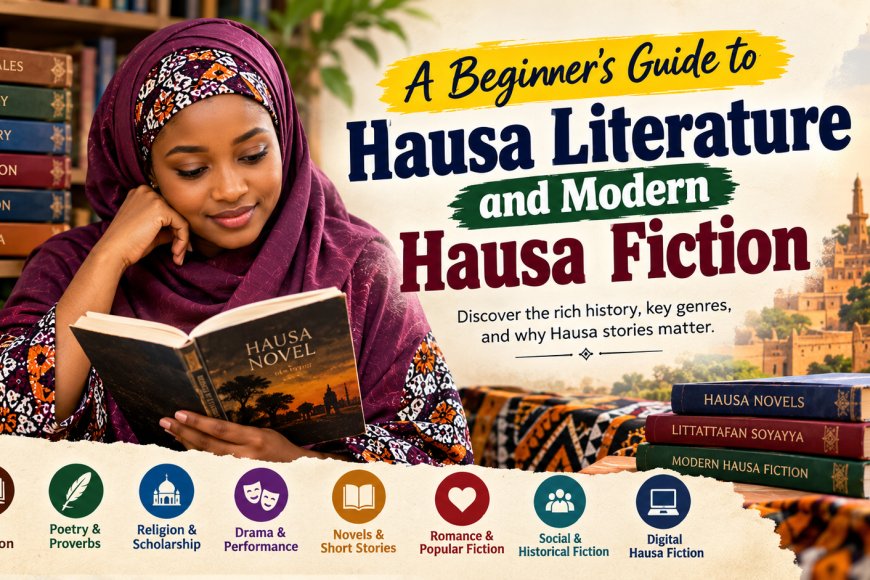
A Simple Map of Hausa Literature
For a beginner, it may help to think of Hausa literature in several broad areas:
Oral literature
Folktales, proverbs, riddles, songs, and traditional storytelling.
Poetry and religious writing
Poems, teachings, devotional works, and scholarly texts.
Drama and performance
Plays, stage writing, radio drama, and related forms.
Printed fiction
Novels and short stories distributed as physical books.
Popular romance fiction
The large tradition of soyayya and relationship-centred stories.
Social and literary fiction
Stories examining society, politics, family, history, identity, and other subjects.
Digital Hausa fiction
Stories distributed through websites, apps, social platforms, ebooks, and online communities.
These categories overlap.
A single work may belong to several at the same time.
Why Hausa Literature Matters
Hausa literature matters because language carries more than words.
It carries memory.
It carries humour.
It carries values.
It carries arguments.
It carries history.
It allows people to describe their world using expressions and perspectives that belong naturally to their language.
For Hausa speakers, literature can provide the experience of seeing familiar places, relationships, conversations, and concerns reflected in stories.
For learners and researchers, it can provide a window into a large and constantly changing literary culture.
And for writers, it provides something equally important:
a tradition to build upon.
Final Thought
You do not need to know every famous writer or literary movement before enjoying Hausa literature.
Begin with stories.
Read widely.
Notice how characters speak, how conflicts develop, how families influence decisions, and how writers combine old traditions with modern life.
Then move beyond the stories you normally read.
Explore poetry.
Explore older works.
Read social fiction.
Read writers from different places and generations.
The deeper you go, the clearer one thing becomes:
Hausa literature is not a single genre or a single type of story. It is a broad literary tradition that continues to grow as Hausa-speaking writers find new ways to tell old and new stories.